The Waldman Curriculum — design research initiative
Chapter 02 · Design Research Initiative · Banu Alpay Waldman · 2026

The Waldman
Curriculum.

Banu Alpay Waldman · Austin, Texas · 2026
What this is

A craft and prototyping learning environment for K–8. Sloyd pedagogy, physical computing, spatial design, and AI literacy — in a single coherent system. Not a school proposal. A design conviction made tangible.

The premise

A child who knows how to look at the sky and read the clouds does not need an app to tell her what the weather will do. That capacity — thinking before reaching — is what this curriculum is built to develop.

The window

K–8 is when a child learns what to trust. If the first tools in her hand are honest — wood, soil, her own work — she builds the instincts every future judgment will rest on. The curriculum is designed for that window and nothing else.

§ 01 · Conviction
"Making by hand as the anchor of every discipline — not the decoration."
Personal conviction
The personal conviction

The hand
learns
first.

I have thought about this for a long time. What I want — and what I could not find in any existing K–8 curriculum — is a learning environment where making by hand is the anchor of every discipline, not the decoration. The Waldman Curriculum is that idea made into a system.

The problem we are solving
Making by hand teaches you to think twice — because you cannot undo the cut. You learn the grain of the wood before you learn the grain of an idea. Modern K–12 has almost entirely removed the hand from learning, and judgment has been removed with it. The curriculum exists to put both back.
The alternative
What if instead we gave children the freedom to build real things — their own tools, their own spaces, their own aesthetic? Every discipline in the curriculum returns her to the same capacity: body knowledge first, abstract knowledge second, never the reverse.
The operating principle
The adult is the mentor. The child leads with curiosity. New tools and new subjects enter the curriculum only when the hand has earned the right to use them well. Developing an education for children requires care, patience, consistency, and follow-through — which is where most modern schooling quietly fails.
§ 02 · The Thesis
"Between the child who makes something real, and the child who has never needed to."
Design thesis

"A child who learns to trust their hands will always have an advantage over a child who learned to trust a screen first. The Waldman Curriculum is the space between those two futures."

Banu Alpay Waldman · 2026
§ 03 · The Curriculum
"The sequence is the argument. Each discipline is the foundation for the one that follows."
K–8 framework
The applied design output

Eight disciplines.
One sequence.

K–8. Each discipline trains a specific cognitive or creative capacity, sequenced so that what a child learns in one becomes the foundation for thinking in the next. Body first. Eye second. Mind third. The order cannot be skipped.

01 · Foundation · K–3
Sloyd & Woodworking
Local Texas materials. Hand tools. Think twice before you cut — because you cannot undo it. Structure and function, learned through making.
02 · Making · K–5
Creative Thinking
Ideation, problem framing, fail-forward iteration. Entrepreneurial ability built at the level of a hypothesis, not a business plan.
03 · Attention · K–8
Observation & Field Study
Drawing from life. Field journals. Reading weather, tracks, seasons, the sky. The foundation every other discipline quietly depends on — and rarely taught anywhere.
04 · Perception · K–5
Art & Aesthetics
Light, dimension, emotional impact. Building an aesthetic beyond algorithmic content — a taste that is yours, not the feed's.
05 · Environment · 2–6
Permaculture & Nature
Grow food. Read the sky. Navigate without a device. The exterior is a living laboratory — body knowledge comes before anything abstract.
06 · Space · 3–8
Spatial Design
Dream a space. Build it. Light, proportion, and how the built environment shapes the thinking inside it. LEGO as design hypothesis.
07 · Systems · 4–8
Creative Technology
Physical computing, robotics, digital fabrication. Introduced late on purpose — once the hand already knows what it wants to make.
08 · Voice · 4–8
Language of Presentation
How to communicate what you made to people who weren't there when you made it. Cinematography, stage design, the vocabulary of showing your work.
Throughout — not a subject, the operating system
Free Play · Creative Play · Nature Play · Design for Play
Play is the condition under which everything else is learned. It is not a subject on the list — it is the air the list breathes.
K–8
Grade span
8
Disciplines
3
Spatial rooms
2031
Design horizon
Curiosity
§ 04 · The Space
"A classroom is the wrong word for what this is. Not a playground. Not an installation. A third thing."
Spatial framework
The learning environment

Paul Friedberg meets
Yayoi Kusama.

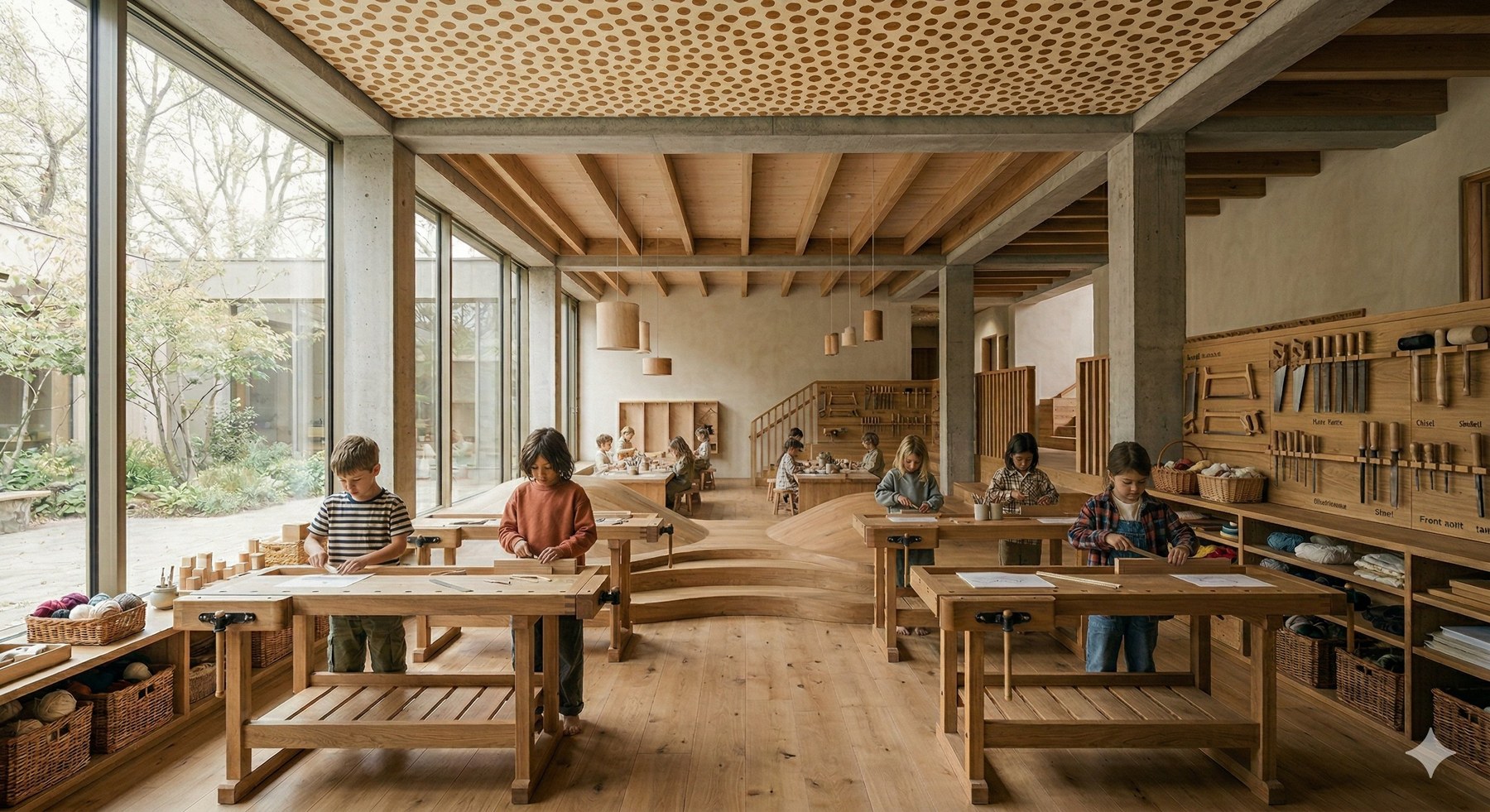
The Waldman school environment is not a classroom or a playground or an art installation. A third thing. The 1960s NYC playground logic — split-level topography, material honesty, no prescribed use — meets Kusama's perceptual field conditions.

Room 01
The Workshop
The Main Workshop
Ground floor, the hands.
Split-level floor, timber mounds, sunken making zones. The sky always visible through north-facing glass. The ground where the hand does its work.
Alvar Aalto light · Friedberg topography
Room 02
The Threshold
The Nature Threshold
Inside opens outside.
A covered threshold between classroom and garden. Soil and tools in the same frame as architecture. Where the school quietly ends and the real world begins.
Living laboratory
Room 03
The Observatory
The Sky Observatory
Flat on your back, looking up.
An elevated platform with a large skylight. A child on her back, looking up at actual clouds. The room exists to make looking a form of study.
Attention, rehearsed
The principle
The space teaches before the lesson begins.
Friedberg's level changes signal what kind of thinking happens where. The sunken making zones say: this is where you focus. The elevated observatory says: this is where you look. The nature threshold says: the real world begins here. The child understands all of this before any adult explains it — because it is designed into the space, not announced by a sign.
Austin, Texas — first branch · establishes the DNA for all that follow
A child who is trusted to make real things — with her own hands, in a space designed for her to think in — learns to trust her own judgment for the rest of her life. That is the entire argument. Everything else is the implementation.

This chapter is a pedagogical framework and a spatial thesis. The curriculum and the learning environment are original IP — developed as a single coherent system, not two separate proposals.

← Back to the landing panel