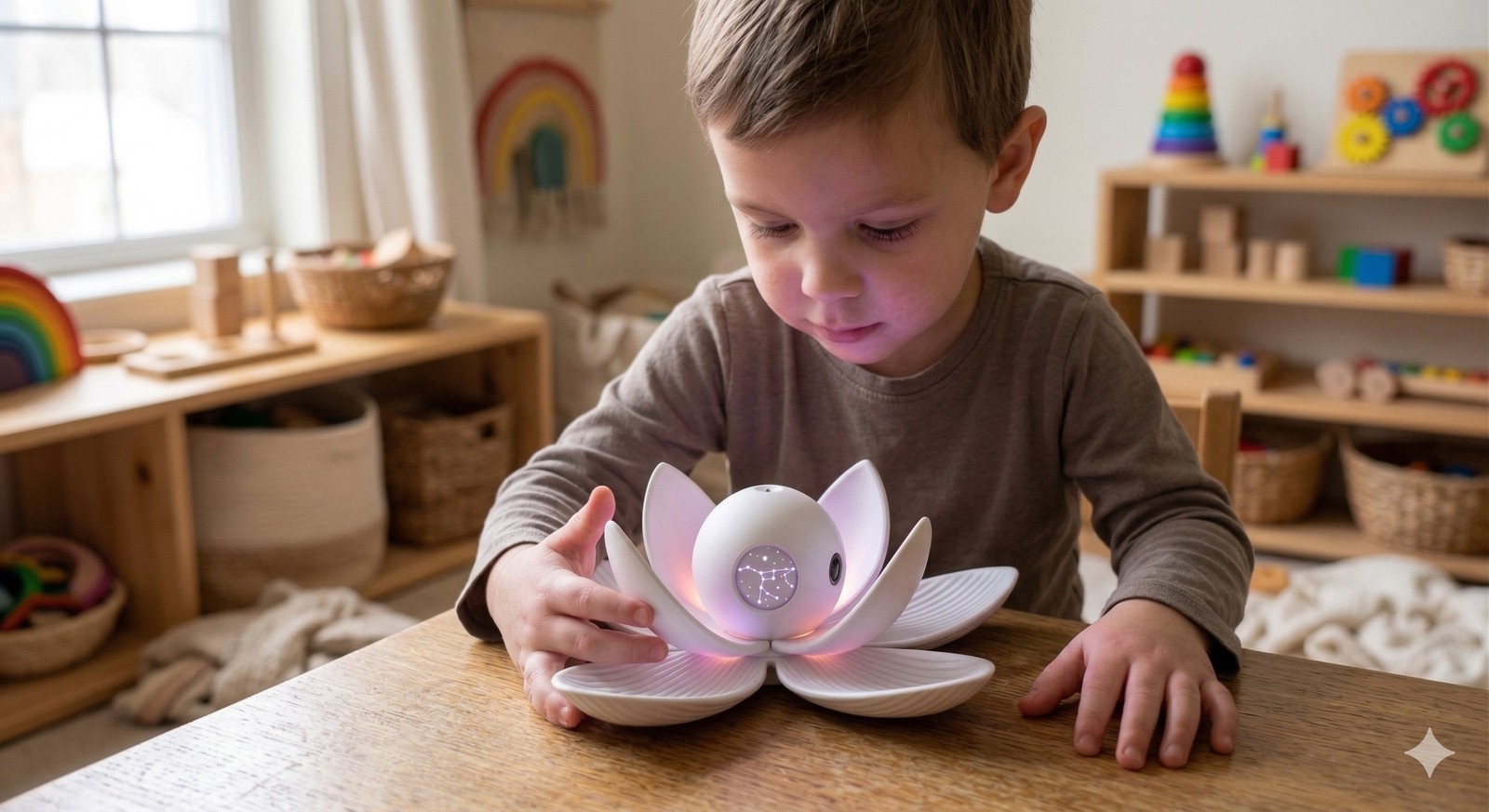
Lotus device — image generated with AI, concept generated by BAW
Chapter 01 · Design Research · Banu Alpay Waldman · 2026

A Design Perspective
on Technology
Worthy of Her Generation.

Banu Alpay Waldman · Austin, Texas · 2026
The question

What if a child's first relationship with technology was one of care rather than consumption? What if the object they first held was ambient, alive to their presence, and designed to grow with them — not to capture their attention?

The argument

Technology has forgotten what it was supposed to feel like. This document is a design framework for remembering — and for building the device ecosystem that follows from that conviction.

The output

A behavioral design thesis grounded in 2.5M AI conversation data points, generational research, and a three-stage device ecosystem — A→B→C — designed to grow from first play object to professional tool. Original IP.

§ 01 · Conviction
"The first technology my daughter holds should not be a window she looks through. It should be an object she cares for."
Opening statement
The personal conviction

This begins
with my
daughter.
And a lotus.

"The first technology my daughter holds should not be a window she looks through. It should be an object she cares for."

The first device a child touches today is transactional in the most taken-for-granted way. The magic is gone before it begins. iPads are tools for AI education. Screens are delivery mechanisms. The relationship between child and device is one of consumption — fast, frictionless, and forgotten. We have normalized the extraordinary and made it ordinary in the worst way.

I don't think technology, common goods, fast consumption should stop serving a purpose for developing world-conscious humans. But I do think the first relationship matters more than any that follows. What a child learns to expect from an object in their first years of interaction with technology — whether they expect it to respond to them, to know them, to be cared for by them — shapes every relationship with technology that comes after.

What I want is different. I want to design — and eventually build — technology that grows with them and enables them, rather than addicts them. Agency over their digital footprint, their skills, and eventually their own personal AI — an intelligence that learned them when they were five and pressing buttons to see what the buttons would do, and that remembers who they became because it was there. The goal is not to prepare children for technology. It is to prepare them to govern it — with hands that already know how to make something real. That is the only version of this relationship I am interested in designing.

§ 02 · The Design Problem
"Technology has become optimized for engagement — which is a clinical word for capture."
The design problem
The contrast

What technology
became vs what it
was supposed to be.

Technology has become optimized for engagement — which is a clinical word for capture. The metrics that govern product decisions at scale are time-on-device, return rate, notification response. These are addiction metrics dressed as success metrics.

The design brief that follows

An object that
earns its place.

What would it mean to design a device with the same design philosophy as the brick? Not nostalgia — application. A device that responds to presence without demanding attention. That grows more itself over time rather than more generic. That a person would notice if it were gone — not because they were addicted to it, but because they had built something real with it.

This is the design brief for the device ecosystem that follows in this document. Three stages. One continuous relationship. One gesture that carries forward from age three to the professional world. The same object, grown up.

§ 03 · The Generation
"They already know who they are. The question is whether the objects designed for them will respect that, or ignore it."
Gen Z / Gen Alpha
The generation this is designed for

They already know
who they are.

Gen Z and Gen Alpha are not waiting for permission to express themselves. The question is not whether they will define their own aesthetic — they already are. The question is whether the objects designed for them will respect that, or ignore it.

Observation 01
Self-expression is already borderless
Nails, skin, ears, timelines, 3D-printed accessories, canvases made without institutional permission. The persona they build will change and expand throughout their lives. Their aesthetic is not fixed — it accumulates. Their tools should do the same.
Observation 02
Skill access is already democratic
They 3D print solutions to problems before they have a job title. They learn cinematography from YouTube before any school teaches it. Their access to craft knowledge is not gated by institution. Their devices should honor that — not constrain it behind a software wall.
The design question
Why shouldn't their productivity device evolve with them — stylistically?
Their first professional tool arrives looking the same as everyone else's. Generic. Institutional. Nothing about it acknowledges who they already are or signals where they are going. The device that takes you seriously before anyone else does looks nothing like that.
§ 04 · The Devices
"It could look like a lotus origami when it's idle — and blossom to show you how the stars align above you."
Device ecosystem A→B→C
The applied design output

A device
that
remembers.

A haptic-first device ecosystem that grows with the person. The material memory, the proximity gesture, and the personal intelligence layer carry forward across all three stages. What changes is proportion, context, and scale of agency. What doesn't change is the relationship.
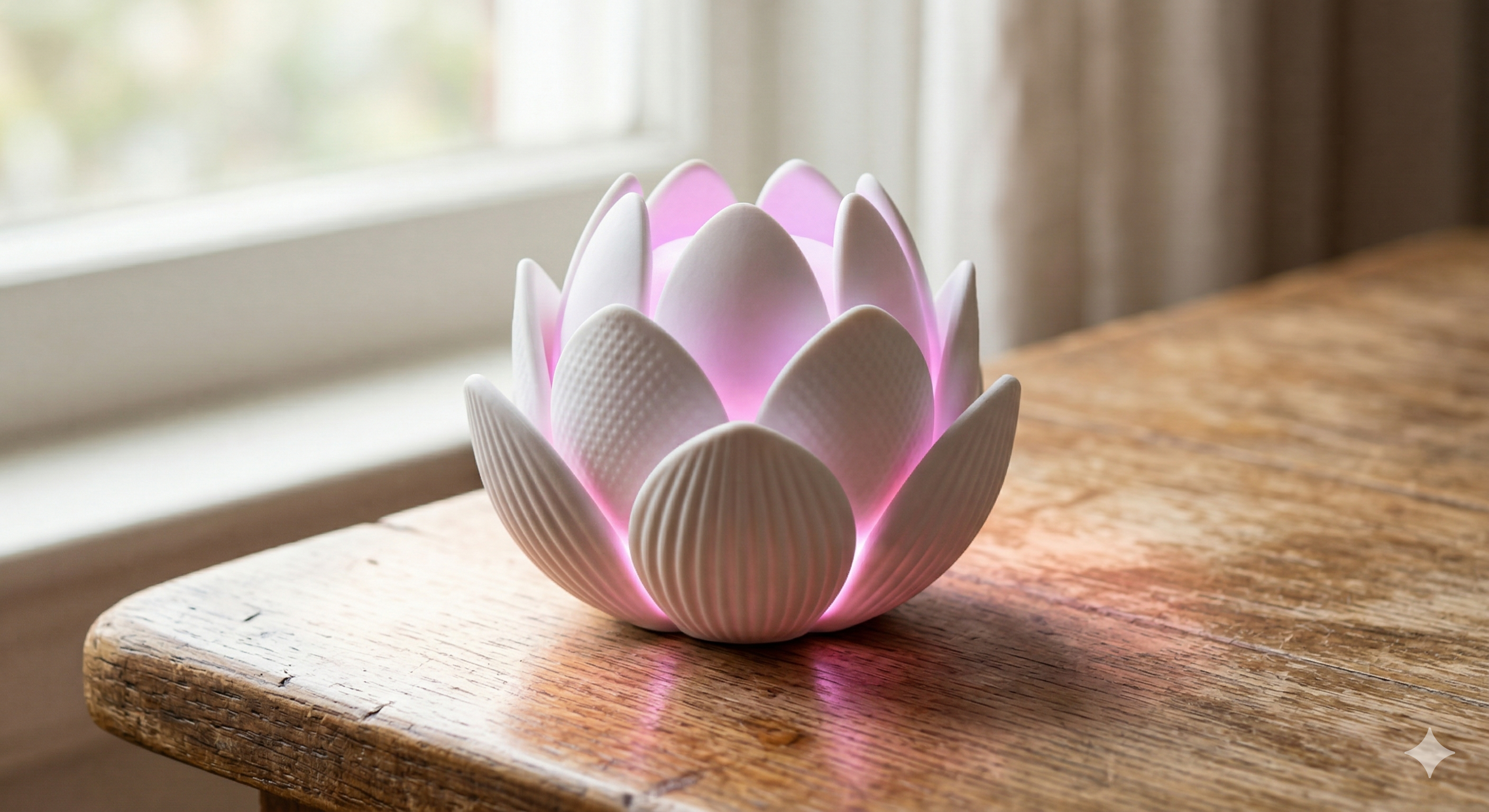
Lotus device in its idle, closed state — image generated with AI, concept generated by BAW
Idle "...closed like a lotus origami..."
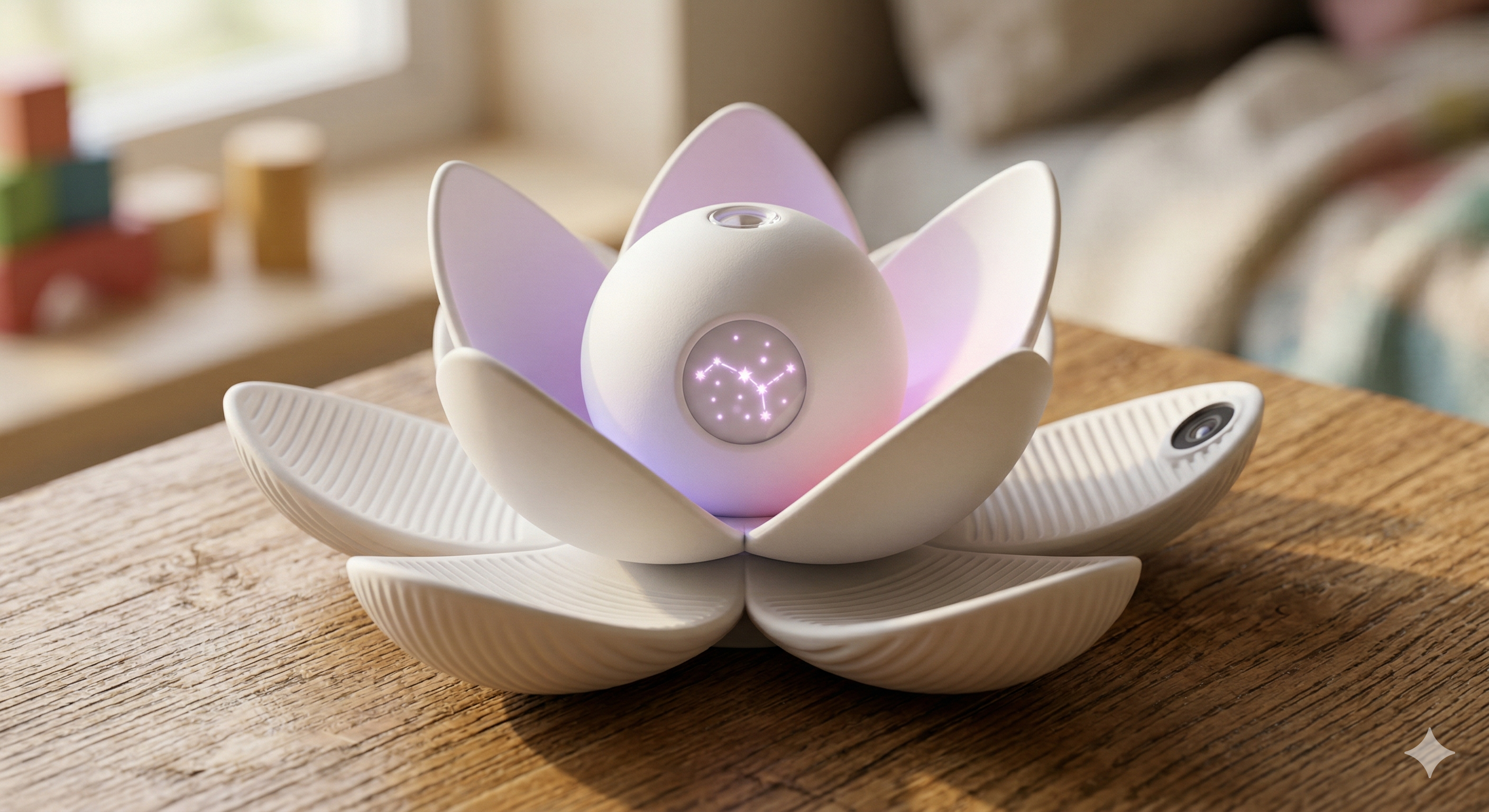
Lotus device blooming — image generated with AI, concept generated by BAW
Blooming "...showing the stars above you."
The design idea

An ambient device that closes like a lotus when idle. When the child approaches, it opens — and shows them the exact position of the stars above them right now, in this moment, above this exact place where they are standing. Not a screen to look through. A relationship with where they are.

Why this matters

This is not a new product category. It is a new design philosophy for an existing one. The object is secondary to the relationship it creates. Care, presence, and wonder are not features — they are the primary design intent. Everything else is specification.

Stage A
Device A · Ages 3–5 · Pre-literacy
The First Object
The Lotus Companion
A warm, rounded object with translucent petals that glow from within. Closes like a lotus when idle. Blooms when the child approaches — projecting visuals onto nearby surfaces: stars, colors, shapes, the weather outside. Touch a petal and it gives sound. Simple gestures — defined by the child — record fragments of the world around them: a birdsong, a parent's voice, a rhythm she invented. One button remains unprogrammed, waiting for the child to decide what it does. The device makes melodies, captures the world, and projects it back — without a screen, without text, without needing to read.
Bio-based PP + translucent TPE petal skin — warm amber glow
Surface projection — visuals cast onto walls, floors, ceilings
Sound on touch — each petal responds differently
Gesture-based recording — the child defines the gestures
One blank button — the child decides what it does
Stage B
Device B · Ages 8–16 · Literate, developing taste
The Hub
Screen-flexible by Default
The screen is present but not primary. The device connects to nearby displays — a TV, a monitor, a classroom projector — or casts content directly onto a wall. The real estate for viewpoints exists, but the child decides when to use it. The core idea is flexibility and deliberate screen time reduction. The Hub embraces the growing ecosystem of devices the child will use as they become literate and develop their own taste — stylus, wearables, phone, personal AI agents. It is the center of that ecosystem, not a replacement for any single part of it.
Display-flexible — connects to nearby screens or projects onto surfaces
Ecosystem hub — stylus, wearables, phone, AI peripherals dock in
Screen time is deliberate, not default
Collapsible bio-composite chassis — portable, resilient
TPE skin accent — material continuity from Device A
Stage C
Device C · Adult · The maker's tool
The Professional Device
Learn by making. Make by learning.
A maker device — the machine that helps you learn skills as you execute your ideas. Dual-surface screen for multi-modal input and output. Peripherals connect magnetically for easier transport — detach, reconfigure, carry what you need. The accumulated intelligence from Device A forward is preserved at the privacy level of the owner's choice: core memories, creative identity, the history of every project and every skill earned — carried into adulthood like a second mind that knows you because it grew up with you.
Dual-surface screen — multi-modal I/O, two working planes
Magnetic peripheral connection — detach, reconfigure, transport
Accumulated intelligence — preserved at the owner's chosen privacy level
Core memories carried forward — creative identity from childhood
A maker's tool — learn skills as you execute ideas
Device sketches in progress — renders to follow. Text specifications are the working document.
One material family. One accumulated intelligence. A device that began by recording a three-year-old's birdsong and grew into the most capable professional tool she has ever held — because it remembers who she became.
The continuity is not mechanical — no device slots into the next. The connection is felt: the same translucent skin, the same proximity awareness, the same personal AI that first learned her presence patterns as a child. The screen grows in importance across stages but never becomes the primary relationship. What carries forward is the intelligence, the creative identity, and the core memories — at the privacy level she chooses.
§ 05 · The Material
"The hand remembers the material even when the eye sees something entirely different."
CMF continuity
Material system — Color · Material · Finish

The same skin
grown up.

The CMF family across all three devices signals developmental continuity without nostalgia. The material is recognizable across stages but never the same object twice.

Material — bio-based PP
Honest, sustainable, warm
Bio-based polypropylene from sugarcane or tall oil — same performance as fossil PP, same tooling cost, honest environmental story. The ground material across all three stages. Becomes darker, denser, and more architectural as the device ages.
Finish — TPE skin accent
The touch that carries forward
Thermoplastic elastomer over-molded skin — the warm amber translucent quality of Device A compresses to a grip zone on Device B and a single copper-toned haptic accent on Device C. The hand remembers the material even when the eye sees something entirely different.
The design signature
Light through skin
At low pigment load, the TPE skin transmits light from within — warm amber glow, diffuse and biological rather than sharp. This is the lotus effect in material terms. The device's awareness of your presence expressed through the skin before any interaction begins.
A device that remembers — from a child's wonder to a grown adult's professional authority. One material family. One relationship — designed for care, not capture.

This chapter is a design framework and an argument. The devices are original IP — sketches, renders, and specifications are the applied output of the thesis above.

← Back to the landing panel